Research
Vision
As civil and environmental systems face escalating challenges from natural hazards, environmental variability, urbanization, and evolving industrial activity, infrastructure resilience has become a critical societal challenge. Disruptive events such as extreme heat, poor air quality, flooding, and seismic hazards increasingly affect infrastructure, leading to economic losses and risks to public safety. These challenges are further compounded by uncertainties in both natural systems and infrastructure responses.
My research focuses on developing uncertainty-aware modeling approaches to support resilient and sustainable infrastructure and environmental systems. I integrate probabilistic methods, digital modeling, and large-scale environmental data to quantify risk, assess system performance, and inform decision-making.
In the Context of Digital Twins
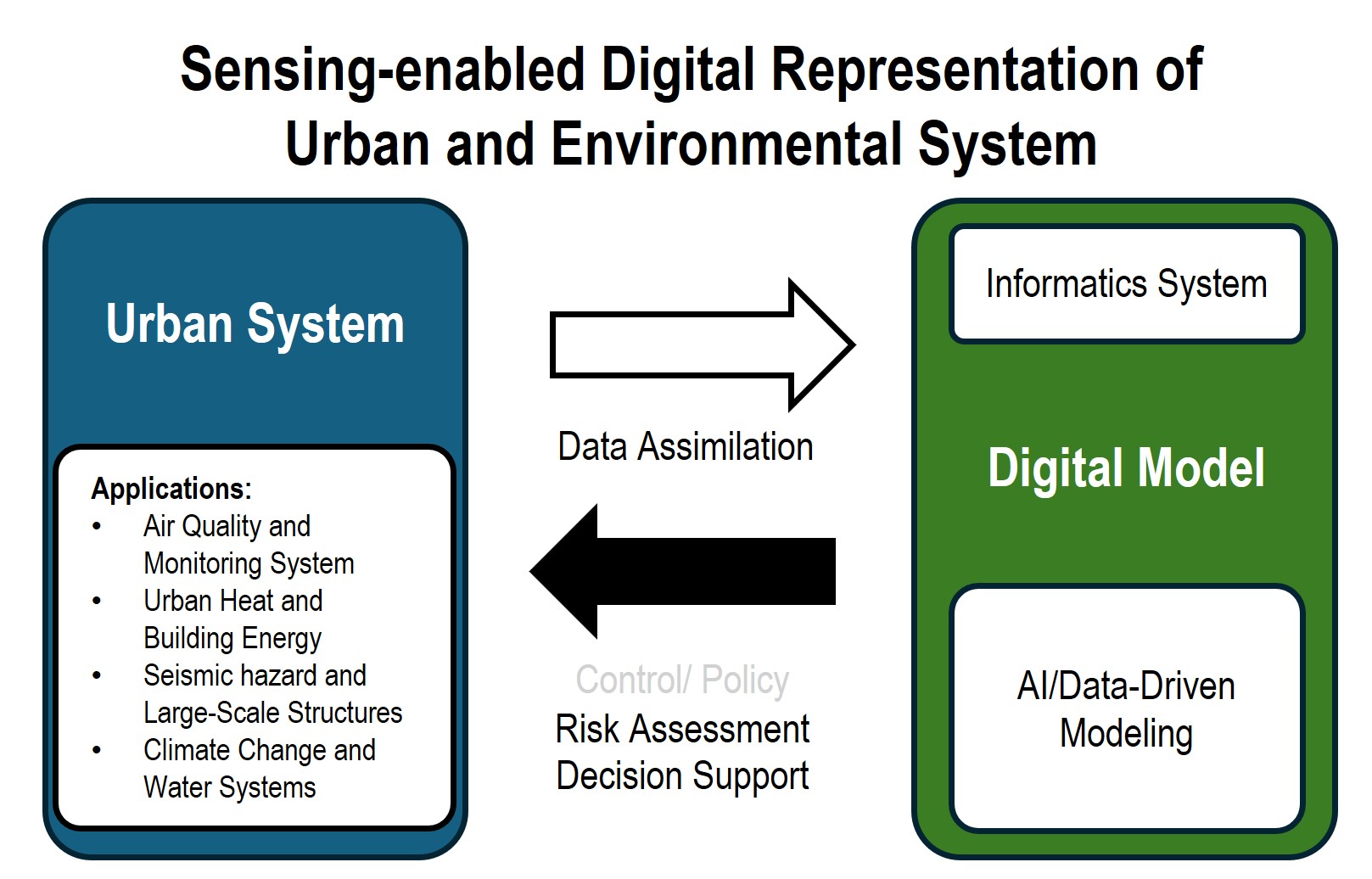
In the era of digital twins, my research develops sensing-enabled digital models of urban and environmental systems to support risk assessment and decision support. I integrate AI/data-driven modeling, probabilistic spatiotemporal analysis, and environmental sensing and data assimilation to connect physical systems with their digital representations.
AI-Enabled and Data-Driven Modeling: I develop AI-enabled and data-driven modeling frameworks for urban and infrastructure systems, including machine-learning-based surrogate models and data-driven spatiotemporal models for scalable prediction and uncertainty quantification of environmental processes such as air quality and urban heat.
Sensing-Enabled Digital Representations of Urban Systems: Building on AI-enabled and data-driven predictive modeling frameworks, I develop sensing-enabled digital representations of urban and environmental systems by integrating environmental sensing, probabilistic modeling, and data platforms. This includes value-of-information approaches for optimal sensor network design and web-based platforms for real-time dissemination of environmental observations.
Risk Assessment and Decision Supports: These sensing-enabled predictive frameworks support risk assessment and decision-making in infrastructure and environmental systems under uncertainty. My research addresses risks across multiple domains, including large-scale structural systems, urban heat and building energy systems, air pollution and environmental sensing systems, and water systems under climate change.
Detailed Experiences
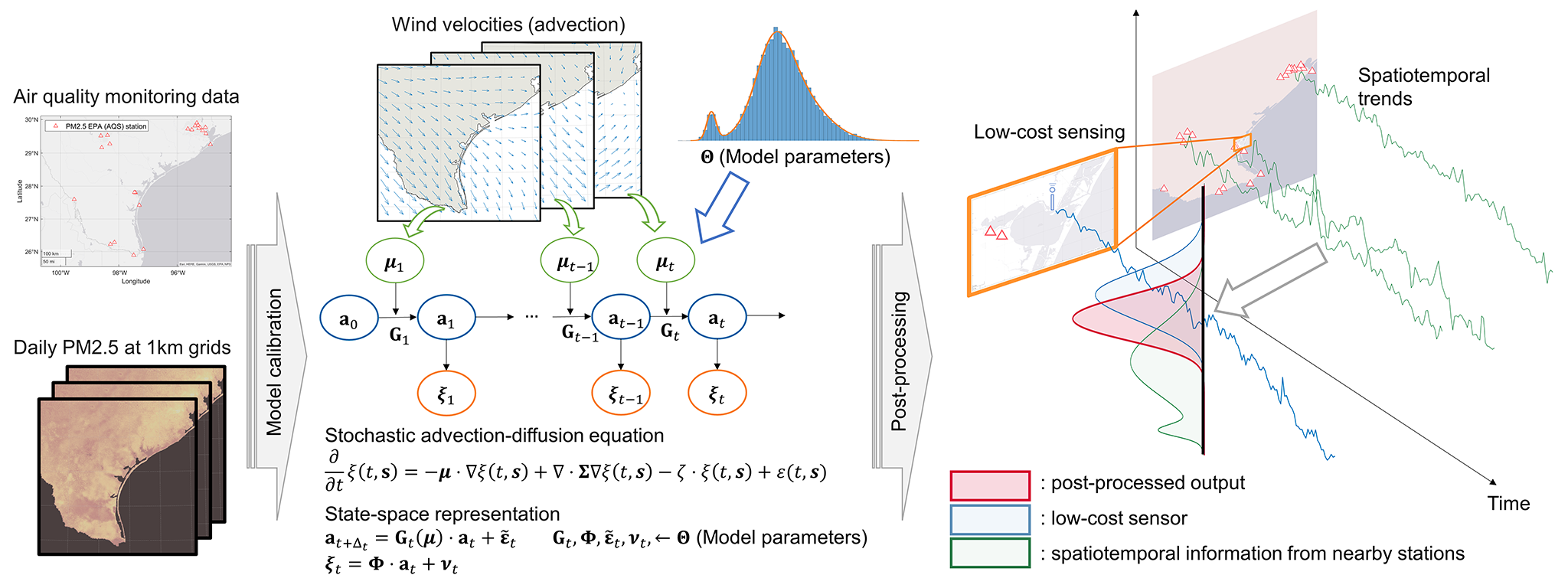
Environmental Monitoring and Sensor Network Design: My postdoctoral research addresses emerging environmental risks in coastal communities, where new industrial activities pose environmental threats, by developing uncertainty-aware environmental monitoring frameworks. I introduced a probabilistic spatiotemporal model to integrate multimodal air quality data, enable data fusion and smart sensing, and predict fine particulate matter concentrations with improved spatial resolution. This approach provides uncertainty-quantified outputs to support decision-making and public health risk mitigation. Building on this framework, I developed a value-of-information approach for optimal sensor network design. In parallel, I led the development of a web-based data-sharing and visualization platform that disseminates air and water quality information from regional sensor networks.
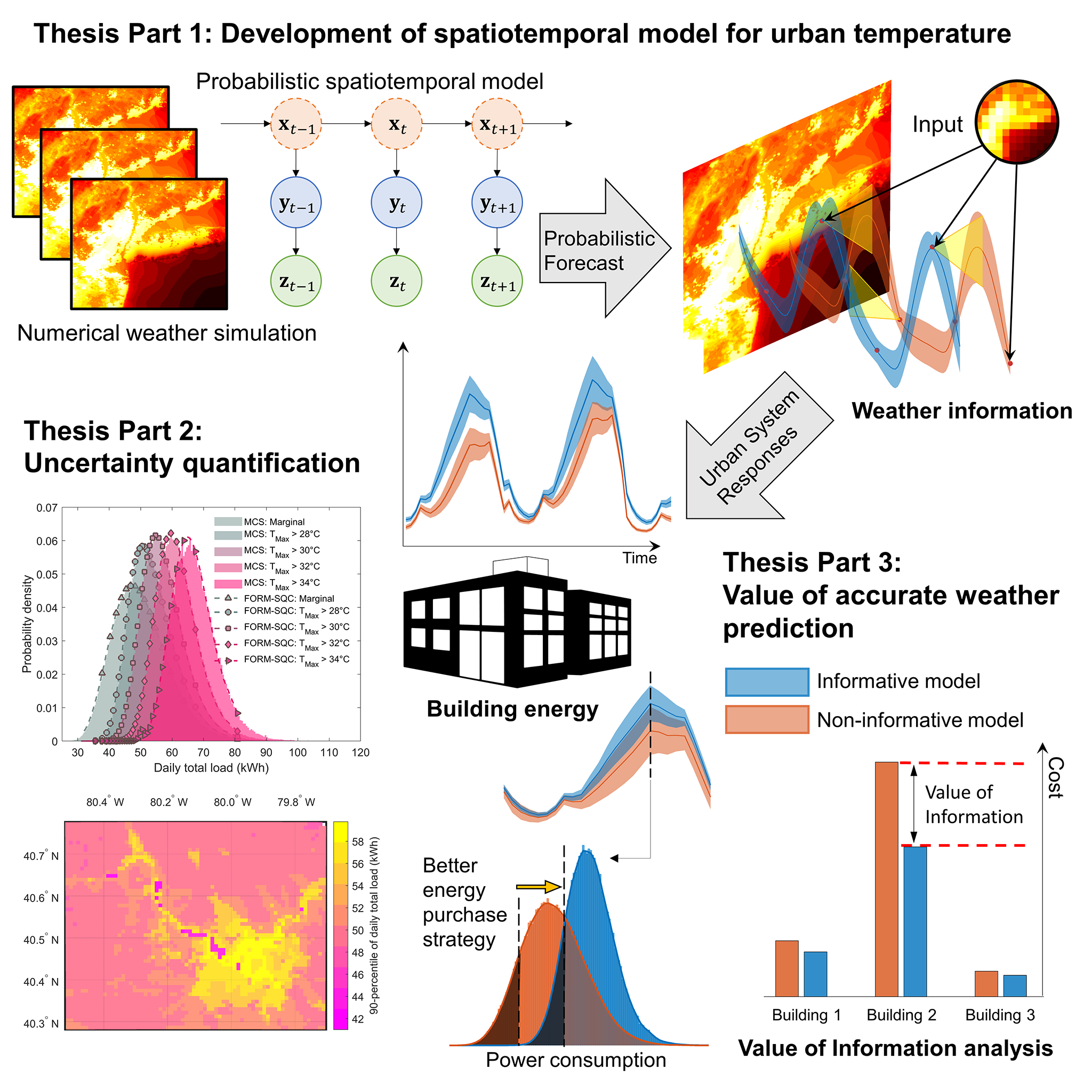
Urban Heat, Building Energy, and Electricity Purchase Planning: During my Ph.D. at Carnegie Mellon University, I investigated the relationship between urban heat and building energy use. Based on an uncertainty-aware spatiotemporal model for urban temperature, I assessed how uncertainty in localized temperatures influences building energy demand and evaluated the economic benefits of accurate temperature modeling for energy cost reduction through improved decision-making. This work advances environmental modeling of urban climate and provides insights into sustainable energy and building system planning.
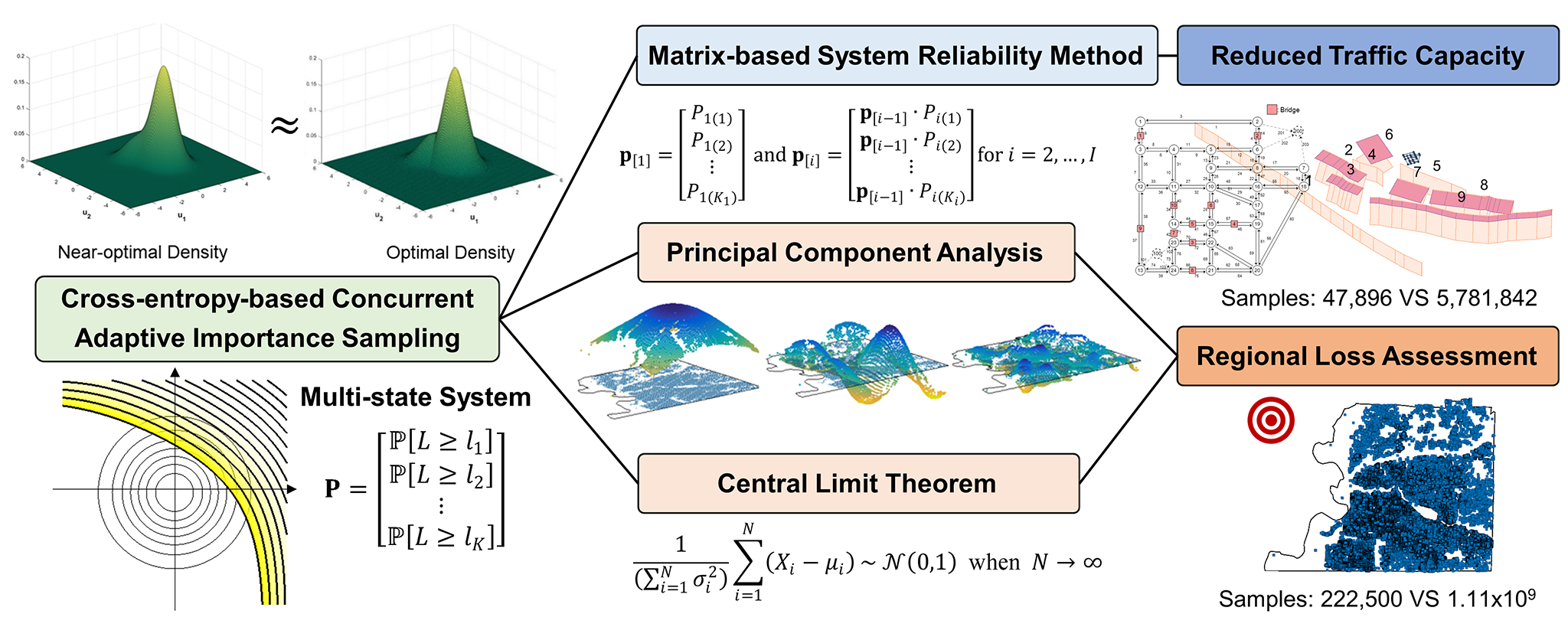
Urban Resilience and Risk Assessment: I have conducted system-level risk analysis in spatially distributed urban infrastructures under seismic hazard, with a focus on regional loss modeling. To enable efficient loss estimation at this scale, I developed an adaptive sampling technique that strategically explores the joint space of seismic hazard scenarios and surrogate models for dynamic structural systems that integrate deep neural networks with Gaussian process updating, enabling efficient seismic loss estimation to support urban risk assessment. In parallel, I collaborated on research addressing hydroclimatic uncertainty in large-scale water systems and extreme rainfalls,where I contributed probabilistic spatiotemporal modeling techniques to evaluate historical and potential future changes in streamflow and precipitation. This work applied the probabilistic approach to the Colorado River Basin to inform long-term water resource planning.